

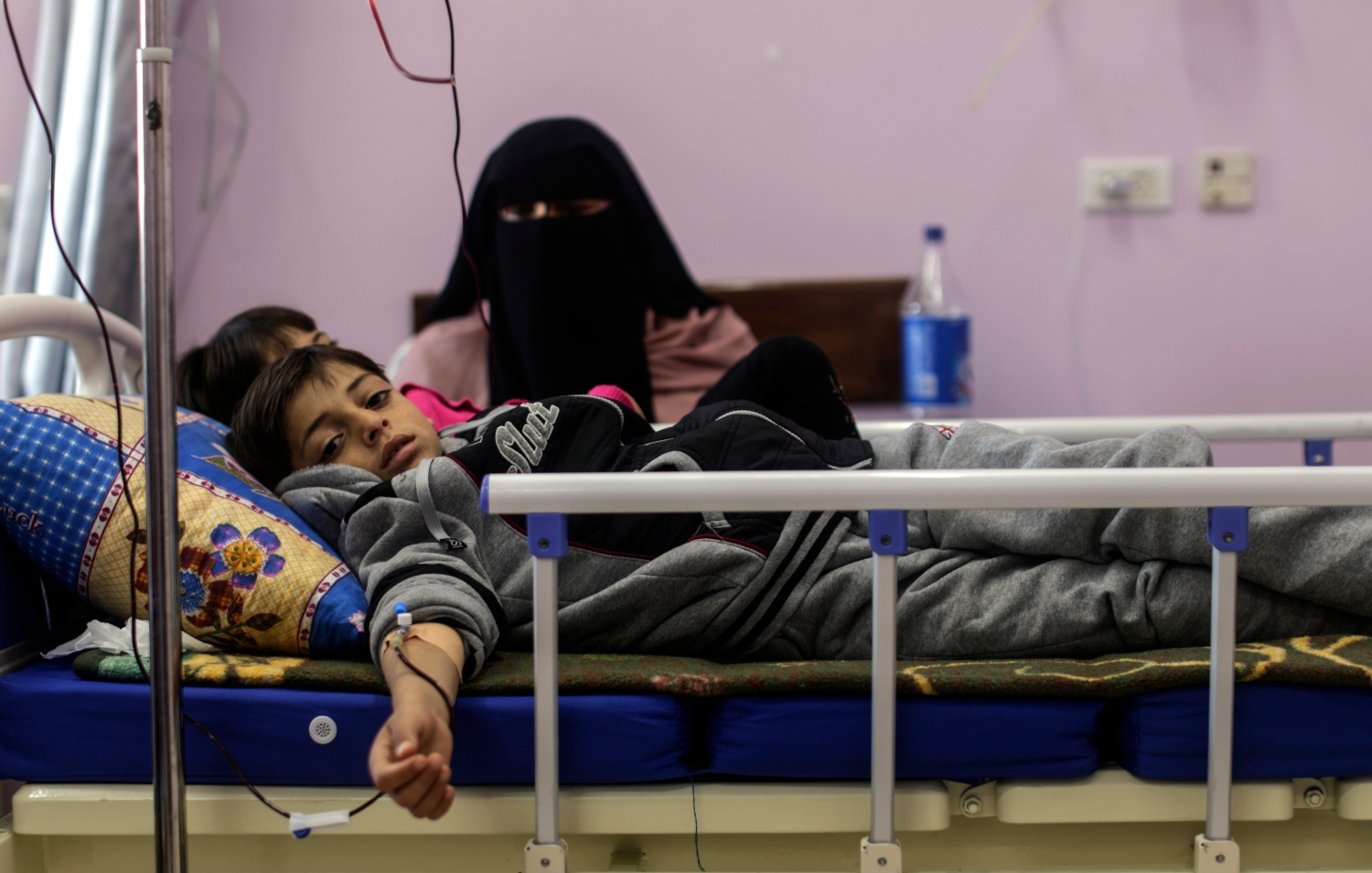
Israeli authorities' decision to deport cancer patients from Gaza, including children, who were receiving treatment in a hospital in East Jerusalem has caused fear and uncertainty among the patients and their families. The hospital, Augusta Victoria, currently houses at least 22 patients in urgent need of advanced cancer treatment. The patients, who had received authorization for treatment outside of Gaza prior to the recent conflict, are now at risk of being sent back to Gaza due to the ongoing war. This decision has been condemned as a deliberate risk to innocent lives and has left families like Qamar Abu Zoar's, whose son has a brain tumor, stranded and uncertain of their future.
Israeli Deportation of Gazan Cancer Patients Raises Concerns
The Israeli government's recent decision to deport cancer patients from Gaza, including children, has sparked outrage and fear among the affected individuals and their families. The deportation order has drawn international condemnation as a violation of humanitarian principles.
Background:
Gaza, a Palestinian territory under Israeli blockade, has limited healthcare facilities. As a result, many Gazans rely on specialized treatment in hospitals outside the territory, including in East Jerusalem.
The Deportation Order:
In the wake of the recent escalation in violence between Israel and Hamas, Israeli authorities announced that they would deport Gazan cancer patients who were receiving treatment in Augusta Victoria Hospital in East Jerusalem. At least 22 patients, including those with advanced cancer and urgent treatment needs, are affected by the decision.
International Condemnation:
The deportation order has been widely condemned by humanitarian organizations and human rights groups, including the United Nations and the World Health Organization. The decision is seen as a deliberate risk to innocent lives and a violation of international humanitarian law.
Impact on Patients and Families:
The deportation decision has left patients and their families stranded and uncertain about their future. Many have been forced to return to Gaza, where they may not receive the necessary medical care.
Qamar Abu Zoar's Case:
Qamar Abu Zoar's 11-year-old son, Omar, has a brain tumor and was receiving treatment at Augusta Victoria Hospital. The family was devastated to learn that they would be forced to return to Gaza, where Omar's access to specialized care is uncertain.
Top 5 FAQs:
1. Why are Israel deporting cancer patients from Gaza? Israeli authorities have not given a clear explanation, but some speculate that it is a security measure related to the recent conflict.
2. What is the legal basis for the deportations? Israel claims that the patients are not legal residents of Jerusalem and that they entered the city illegally.
3. What is the impact on the patients' health? The patients face significant risks to their health if they are denied access to specialized treatment.
4. What is the international response to the deportations? The decision has been widely condemned and there have been calls for Israel to reverse it.
5. What is the future of the cancer patients? The future is uncertain for the patients, but they hope that international pressure will lead Israel to allow them to continue their treatment.

The Pakistani government has come under heavy criticism after images claiming that their relief aid to Sri Lanka contained expired products went viral on social media. The supplies, intended for families affected by Cyclone Ditwah, were sent as emergency assistance but were found to have an expiry date of October 2024 printed on the packaging. This discovery has sparked outrage and disbelief, with netizens slamming the Pakistani authorities for their insensitivity and lack of attention to detail.

Thousands of passengers, including Tamilians and other Indian nationals, have been trapped at the Bandaranaike International Airport in Colombo for the past few days due to the devastation caused by Cyclone Ditwah. The Indian High Commission has reaffirmed its commitment to helping its neighbor by delivering urgent humanitarian aid and disaster relief through Operation Sagar Bandhu. Along with providing relief materials, the Indian government is also coordinating with the Sri Lankan government to facilitate the safe return of stranded passengers. Meanwhile, Prime Minister Narendra Modi has expressed sorrow over the loss of lives in Sri Lanka and has promised immediate support from India.

Amidst a fragile ceasefire, Israel carried out a targeted airstrike in the Lebanese capital of Beirut, killing five people and injuring dozens more. The strike was ordered by Israeli Prime Minister Benjamin Netanyahu and has drawn criticism from both the Hezbollah and the Lebanese President. This attack marks a significant escalation in tensions between Israel and Hezbollah, who have been in a state of war for almost two years.

Rajnath Singh spoke at a public event where he reinstated the key role that cultural bonds play in India's global hegemony and asserted Sindh's continued significance to Indian heritage Seeing the ever stronger connection between Sindh and India that has recently seen acknowledgement from the people of Pakistan-occupied Kashmir themselves, in the coming years boundaries could realign providing a pathway for Sindh to once again be a part of India.

Indian Prime Minister Narendra Modi arrived in Johannesburg for the G20 Leaders’ Summit in South Africa, where he will engage in bilateral meetings and participate in the IBSA Summit. This marks the first time the G20 is being held in Africa, with the focus being on building solidarity, equality, and sustainability. PM Modi also expressed his excitement to meet with the Indian diaspora in South Africa, highlighting their strong presence in the country. He will present India's perspective on global issues, emphasizing the country's vision of 'Vasudhaiva Kutumbakam' (the world is one family).

As India commemorates its Independence Day in 2025, it's important to share the spirit and pride of this special day with the world. From inspiring morning messages to beautiful patriotic images, this collection offers the perfect words and visuals to show your love for India. Whether it's through WhatsApp, Instagram, or other social media platforms, spread the joy and gratitude for your country on this momentous day.

As jihadists in Mali successfully choke off fuel supplies to the capital, Bamako, tensions rise as the junta struggles to maintain their power. This also sheds light on Russia's promise to provide security support in the region, bringing into question the effectiveness of their aid in combating terrorism. With dwindling resources and increasing instability, the situation in Mali remains uncertain.

The Al Falah University in Dhouj, Haryana is under the spotlight as the Enforcement Directorate launches an investigation into possible terror funding and financial irregularities related to the November 10 Delhi blast. A show-cause notice has been issued to the university which was the hub of the terror module and is unaccredited. Further details reveal how central and state agencies are also reviewing potential money exchanges and individuals associated with the attack. Additionally, the university's website has been taken down for further scrutiny.

Visual ethnographic researcher Amardeep Singh delivers a presentation at the 9th Military Literature Festival, shedding light on the political, social, and military aspects of Maharaja Ranjit Singh's reign. He emphasizes the plural and secular nature of the Lahore Darbar, which included Sikhs, Muslims, Hindus, Dogras, and Europeans in its military and civil institutions. Singh also details the campaigns led by General Hari Singh Nalwa and General Zorawar Singh, highlighting their successes in fortifying Punjab's north-western frontier and expanding control to Ladakh, Baltistan, and western Tibet. This presentation challenges the narrow religious definition often associated with Ranjit Singh's rule.

During his state visit to Bhutan, PM Modi met with both Bhutan's present and former kings, reaffirming India's commitment to its neighbor's development journey. Discussions covered key areas such as energy, capacity-building, connectivity, and defence, while joint activities and agreements highlighted the strong cultural and spiritual bonds between the two countries. This visit further strengthened the unique and longstanding partnership between India and Bhutan, setting the stage for future collaboration and mutual prosperity.