

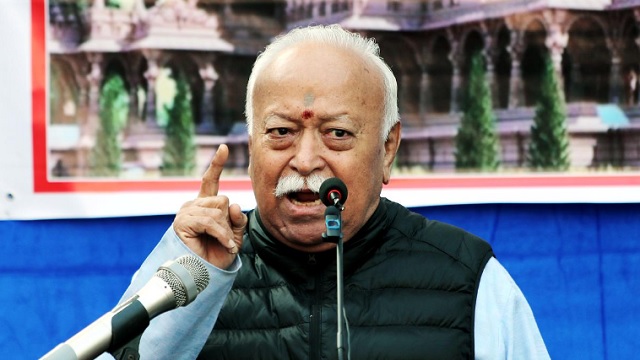
RSS chief Mohan Bhagwat emphasized the need for a balanced approach to development and education, stating that by combining sacred traditions with modern innovations, India can achieve true progress. He called for an education system that is supportive and community-oriented, and praised the National Education Policy for its multidisciplinary approach. Other speakers at the event also emphasized the importance of preserving India's cultural roots while embracing modernity, and expressed concerns about the influence of Western culture on value-based education and family systems.
Mohan Bhagwat's Call for Balanced Development and Education: A Path to Progress
Background:
Mohan Bhagwat, the chief of Rashtriya Swayamsevak Sangh (RSS), India's largest Hindu nationalist organization, recently emphasized the need for a balanced approach to development and education in the country. His remarks come at a time when India faces significant challenges, including economic disparities, social divisions, and the need to modernize its educational system.
Balanced Development:
Bhagwat stressed the importance of combining traditional values with modern technologies to achieve sustainable and inclusive development. He believes that India's rich cultural heritage, rooted in sacred traditions, provides a strong foundation for progress. However, he also recognized the need for embracing modern innovations and scientific advancement to drive economic growth and prosperity.
Education for the Future:
The RSS chief called for a transformation of India's education system. He advocated for a model that is community-oriented, supportive, and promotes holistic development of students. Bhagwat praised the New Education Policy (NEP) for its multidisciplinary approach, which he believes will foster creativity and analytical thinking among students.
Cultural Roots and Modernity:
Bhagwat emphasized the importance of preserving India's cultural roots while embracing modernity. He expressed concerns about the influence of Western culture on value-based education and family systems. He urged for a balance between traditional values and modern education in order to strengthen the nation's foundations and identity.
Top 5 FAQs:
Q1: What is the RSS's stance on education? A: The RSS believes that education should be rooted in Indian cultural values, foster holistic development, and promote critical thinking.
Q2: What are the key elements of the New Education Policy (NEP)? A: The NEP emphasizes multidisciplinary learning, experiential education, and a focus on skill development.
Q3: How does the RSS view the role of tradition in development? A: The RSS believes that traditional values, such as respect for elders and community, are essential for sustainable progress.
Q4: What are Bhagwat's concerns about Western culture? A: Bhagwat believes that Western culture can undermine traditional values, such as family bonds, modesty, and spirituality.
Q5: What is the RSS's vision for India's future? A: The RSS envisions a strong, prosperous, and culturally vibrant India that combines traditional values with modern progress.

As the West Bengal Assembly elections near, the political battle between Bharatiya Janata Party (BJP) and Trinamool Congress (TMC) has intensified on social media. Following the BJP's victory in Bihar, the party declared its hopes to defeat TMC in Bengal on a popular platform, while TMC leader Kunal Ghosh responded with a proverb highlighting the BJP's potential failure in Bengal. Despite BJP's confidence, TMC remains unfazed and asserts their strong hold in the state.

Congress leader and Leader of Opposition in Lok Sabha, Rahul Gandhi, was criticized by BJP's Shehzad Poonawalla for going on a jungle safari in Madhya Pradesh's Satpura Tiger Reserve instead of focusing on the ongoing Bihar elections. Gandhi had earlier claimed that "vote theft" had taken place in several states, including Madhya Pradesh. BJP's Poonawalla mocked Gandhi's "priorities" and referred to him as the "Leader of Paryatan and partying."

The sudden blast in Delhi that left several people dead has shocked everyone, including Bollywood stars Raveena Tandon, Thalapathy Vijay, Vineet Kumar Singh, and Riddhima Kapoor Sahni. While police are investigating all possible angles, including a terrorist conspiracy, Raveena's comments on social media suggest a link to terrorist activity. The celebrities also expressed their condolences to the victims and their families.

In a historic move, the Madhya Pradesh government has announced that it will be releasing 32 prisoners, including nine from tribal communities, on November 15 to mark Janjatiya Gaurav Diwas or Tribal Pride Day. This decision, initiated by Governor Mangubhai C Patel, aims to recognize and celebrate the contributions of tribal communities on the birth anniversary of their icon, Birsa Munda. This is the first time in India that prisoners will be released on grounds of good conduct while serving jail terms. However, it should be noted that the release will not apply to convicts in cases of rape or the Protection of Children from Sexual Offences (POCSO), as well as those convicted in multiple murder cases.

Today marks the birth anniversary of Birsa Munda, a fearless leader and freedom fighter who fought against British colonial oppression and the exploitation of tribal communities. His legacy of social justice and environmental protection continues to inspire movements in India today. As Jharkhand celebrates his birth anniversary, Birsa Munda's life serves as a reminder of the ongoing struggle for justice and sustainability.

Prime Minister Shri Narendra Modi will visit Gujarat on 15th November for various ceremonies and inaugurations. At a programme in Dediapada, he will inaugurate and lay the foundation stone of multiple development projects worth over ₹9,700 crore, with a particular focus on improving infrastructure and empowering tribal communities. These include residential schools, multi-purpose centres, medical institutions, and marketing centres, among others. The projects aim to uplift marginalized communities and promote the preservation of tribal culture and heritage.

As the NDA secures a clear victory in the Bihar elections, social media has been abuzz with questions about the whereabouts of Rahul Gandhi, the leader of the opposition and supposed face of the Congress in the state. With rumours circulating about him being in London or Muscat, there has been no official confirmation from the party or credible media outlets. This has sparked conversations about leadership and commitment within the party.

In a historic election year in Bihar, Gayetri Devi of the Bharatiya Janata Party (BJP) emerged as the winner of the Parihar Assembly seat in the Parihar Vidhan Sabha constituency. This marks Devi's third consecutive win in the region, solidifying the BJP's stronghold in the area. The live results and updates from the counting centers are being closely monitored and reported by News18, providing real-time coverage of the election results.

In a stunning comeback, the Nitish Kumar-led NDA is set to secure a massive victory in the Bihar elections. As counting progresses, the numbers show a clear endorsement of Nitish's social welfare model, particularly among women and marginalized communities. This has also given a boost to the Modi government and solidified the alliance's stronghold in the state. While the RJD tried to tap into student anger and expand their coalition, the NDA's targeted outreach to women, consolidation among upper-caste voters, and support from Chirag Paswan's LJP (R) created an unstoppable wave that the Grand Alliance couldn't counter. Today's victory not only secures Nitish's 10th term as CM, but also validates the BJP's decision to publicly endorse him as the NDA's chief ministerial face.

After a close race, Mangal Pandey of the BJP has emerged as the winner for the Siwan Vidhan Sabha constituency in the 2025 Bihar Assembly elections. The live update on the results, as reported by News18 reporters present at each counting centre, shows BJP taking the lead in the state. This marks a significant win for the BJP, coming after a defeat in the 2020 Bihar Assembly elections.