

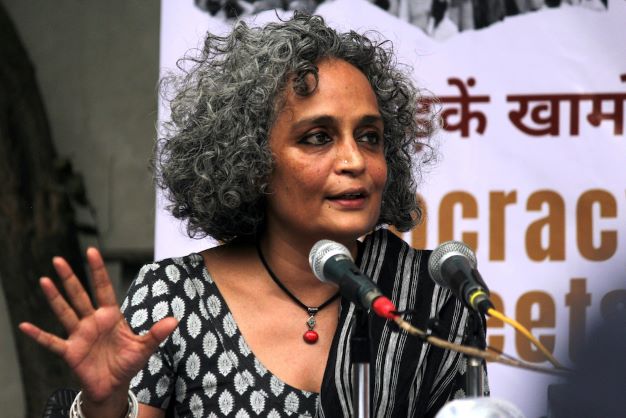
NCP chief Sharad Pawar criticized Delhi Lieutenant Governor VK Saxena's recent decision to prosecute author Arundhati Roy under the stringent Unlawful Activities (Prevention) Act for an alleged provocative speech made 14 years ago. The NCP chief described the move as a "misuse of power" during a joint press conference with Shiv Sena (UBT) chief Uddhav Thackeray and senior Congress leader Prithviraj Chavan. Along with Roy, former Central University of Kashmir professor Sheikh Showkat Hussain has also been named in the FIR for the controversial conference which allegedly advocated for the separation of Kashmir from India.
Background:
The Unlawful Activities (Prevention) Act (UAPA) is a controversial Indian law that allows the government to designate individuals and organizations as "terrorists" and detain them without trial for up to 180 days. The law has been criticized for its broad definition of terrorism, which has led to the arrest and prosecution of activists, journalists, and other dissenting voices.
Current Event:
On February 23, 2023, Delhi Lieutenant Governor VK Saxena ordered the prosecution of renowned author Arundhati Roy under UAPA for an alleged provocative speech she made at a conference in 2009. The speech was titled "Azadi: Freedom. Fascism. Fiction." and allegedly advocated for the separation of Kashmir from India.
Response from NCP Chief Sharad Pawar:
NCP chief Sharad Pawar strongly criticized Saxena's decision, calling it a "misuse of power." Pawar spoke alongside Shiv Sena (UBT) chief Uddhav Thackeray and senior Congress leader Prithviraj Chavan at a joint press conference.
Pawar argued that Roy's speech did not amount to terrorism and that the use of UAPA against her was a dangerous precedent. He also said that the move was an attempt to stifle dissent and opposition to the government.
Other Reactions:
Roy has also condemned the charges, saying that she will not be silenced. She has vowed to fight the case in court.
Human rights groups have also expressed concern over the use of UAPA against Roy. Amnesty International called it "a blatant attempt to intimidate and silence a prominent critic of the government."
FAQs:
1. What is the UAPA? The UAPA is an Indian law that allows the government to designate individuals and organizations as "terrorists" and detain them without trial for up to 180 days.
2. Why is Arundhati Roy being prosecuted under UAPA? Roy is being prosecuted for an alleged provocative speech she made at a conference in 2009 that was interpreted as advocating for the separation of Kashmir from India.
3. What has been the reaction to Roy's prosecution? Human rights groups and opposition leaders have condemned the prosecution as a misuse of power and an attempt to stifle dissent.
4. What are the potential consequences if Roy is convicted? Roy could face up to 10 years in prison if convicted under UAPA.
5. What is the significance of Pawar's criticism? Pawar's criticism is significant because he is a senior and respected opposition leader. His statement reflects a growing concern among opposition parties over the misuse of UAPA by the government.

Political activist Salman Ahmad has made shocking allegations that Pakistan’s Army Chief, General Asim Munir, orchestrated a terror attack in Kashmir in order to solidify his power within the country. In an interview, Ahmad claimed that Munir wanted to provoke India into retaliating so he could project himself as a strong military leader. This comes as 42 US lawmakers have called for an investigation into alleged human rights violations by Munir's regime.

The BJP has appointed Nitin Nabin, a five-time Bihar MLA and Cabinet Minister, as its national working president. This move is being seen as a potential step towards Nabin becoming the successor of party president and Union Health Minister J P Nadda. Prime Minister Narendra Modi, along with other party leaders, has welcomed Nabin's appointment, and Bihar Chief Minister Nitish Kumar expressed his happiness at a resident of Bihar being elevated to such a high position in the party.

In a special meeting with the Bangalore Apartments Federation, Deputy Chief Minister D K Shivakumar announced the Karnataka government's plans to introduce a new legislation aimed at protecting the rights of apartment owners and residents. He called for feedback from stakeholders to help shape the proposed Karnataka Apartment (Ownership and Management) Bill, 2025. The move comes as apartment living has become increasingly prevalent in Bengaluru, but the current law has not been updated in over five decades. Participants also discussed other pressing concerns in the apartment sector, including resolution of conflicts and better governance through technology.

Government officials in the UK are facing backlash from citizens as Storm Bram brings heavy rain and winds, leading to flood warnings and potential risks to life. Good Morning Britain presenters Richard Madeley and Susanna Reid raised concerns about the lack of warning to those living in affected areas, while viewers expressed frustration over inconsistent warning systems. With severe weather conditions expected to continue throughout the country, citizens are calling for better communication and preparation from their government.

A shocking conspiracy was uncovered by the Bihar Police when they arrested an individual from Bhojpur for allegedly issuing death threats to MP Pappu Yadav. The whole scheme was concocted by his close associates to garner enhanced security for Yadav. The arrested man, Ram Babu, has confessed to making a threatening video at the behest of the MP's associates, who had promised him a position in their party. Police are still investigating the instigator of this plot and are also looking into other aspects of the case.

Congress-led UDF emerged as the leading force in the Kerala local body elections, securing a majority in 505 out of 941 Grama Panchayats. Meanwhile, the BJP-led NDA made significant gains, winning the Thiruvananthapuram Corporation for the first time and retaining key municipalities. Union Home Minister Amit Shah credited the victories to PM Narendra Modi's leadership and vision for "Vikasita Keralam".

In a significant victory for the Aam Aadmi Party (AAP), three women candidates secured seats in the Kerala local body elections. Former Mayor and MCD AAP Councillor Dr. Shelly Oberoi congratulated the winners, praising their success as a strong example of women's empowerment. Meanwhile, Congress president Mallikarjun Kharge expressed his gratitude to the people of Kerala for giving a decisive verdict in favor of the United Democratic Front (UDF), while Prime Minister Narendra Modi acknowledged and praised the efforts of BJP workers in the state. This outcome reflects the increasing support for female leaders and potentially hints at a greater shift towards progressive politics in the state.

As the counting for the local body elections in Kerala began, the Congress-led UDF is in the lead in most of the city and town local bodies. This two-phase election, held on December 9 and 11, has seen a high voter turnout of over 70%. The results of this election will have a significant impact on the political landscape ahead of the 2026 Assembly elections in Kerala, with local body results often reflecting voter mood. Congress president Mallikarjun Kharge has expressed confidence in the UDF alliance's chances in the upcoming Assembly polls.

R Sreelekha, the former DGP and BJP's mayoral candidate in Thiruvananthapuram Corporation, secured a victory in the Sasthamangalam ward and pledges to deliver a corruption-free administration if given the chance to serve the public. Other notable victories in the corporation elections include former district president VV Rajesh and UDF mayoral candidate KS Sabarinathan. However, some high-profile defeats were seen, including actor Poojapura Radhakrishnan and Congress leader Johnson Joseph. Independent candidate Pattoor Radhakrishnan and Congress candidate Mary Pushpam also emerged victoriously in their respective wards.

According to sources, the Special Intensive Revision (SIR) exercise in West Bengal has identified a total of 58,80,202 voters who may be excluded from the draft voter list. This includes people who have passed away, transferred, missing, and identified as 'fake' by the Election Commission. These numbers are subject to change in the final list, which is set to be published on February 14, 2022. The commission has divided voters into three categories - own mapping, progeny mapping, and non-mapping - depending on their presence in the 2002 voter list. Those not falling into any of these categories will be called for a hearing by the EC.